Introduction
Precipitation, evaporation, and transpiration are
all terms that sound familiar, yet may not mean much to you. They are all part
of the water cycle, a complex process that not only gives us water to drink, fish to eat,
but also weather patterns that help grow our crops.
Water is an integral part of life on this planet.
It is an odorless, tasteless, substance that covers more than three-fourths of
the Earth's surface. Most of the water on Earth, 97% to be exact, is salt water
found in the oceans. We can not drink salt water or use it for crops because of
the salt content. We can remove salt from ocean water, but the process is very
expensive.
Only
about 3% of Earth's water is fresh. Two percent of the Earth's water (about 66%
of all fresh water) is in solid form, found in ice caps and glaciers. Because
it is frozen and so far away, the fresh water in ice caps is not available for
use by people or plants. That leaves about 1% of all the Earth's water in a
form useable to humans and land animals. This fresh water is found in lakes,
rivers, streams, ponds, and in the ground. (A small amount of water is found as
vapor in the atmosphere.)
Scientific
Concepts
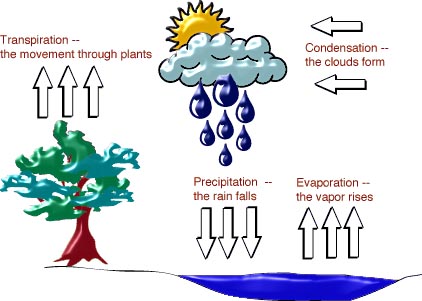
There are six important
processes that make up the water cycle. These are:
Evaporation
Evaporation is
the process where a liquid, in this case water, changes from its liquid state
to a gaseous state. Liquid water becomes water vapor. Although lower air
pressure helps promote evaporation, temperature is the primary factor. For
example, all of the water in a pot left on a table will eventually evaporate.
It may take several weeks. But, if that same pot of water is put on a stove and
brought to a boiling temperature, the water will evaporate more quickly.
Condensation
Condensation is
the opposite of evaporation. Condensation occurs when a gas is changed into a
liquid. Condensation occurs when the temperature of the vapor decreases.
When the water
droplets formed from condensation are very small, they remain suspended in the
atmosphere. These millions of droplets of suspended water form clouds in the
sky or fog at ground level. Water condenses into droplets only when there are small
dust particles present around which the droplet can form.
Precipitation
When the
temperature and atmospheric pressure are right, the small droplets of water in
clouds form larger droplets and precipitation occurs. The raindrops fall to
Earth.
As a result of
evaporation, condensation and precipitation, water travels from the surface of
the Earth goes into the atmosphere, and returns to Earth again.
Surface
Runoff
Much of the
water that returns to Earth as precipitation runs off the surface of the land,
and flows down hill into streams, rivers, ponds and lakes. Small streams flow
into larger streams, then into rivers, and eventually the water flows into the
ocean.
Surface runoff
is an important part of the water cycle because, through surface runoff, much
of the water returns again to the oceans, where a great deal of evaporation
occurs.
Infiltration
Infiltration
Infiltration is
an important process where rain water soaks into the ground, through the soil
and underlying rock layers. Some of this water ultimately returns to the
surface at springs or in low spots downhill. Some of the water remains
underground and is called groundwater.
As the water
infiltrates through the soil and rock layers, many of the impurities in the
water are filtered out. This filtering process helps clean the water.
Transpiration
One final
process is important in the water cycle. As plants absorb water from the soil,
the water moves from the roots through the stems to the leaves. Once the water
reaches the leaves, some of it evaporates from the leaves, adding to the amount
of water vapor in the air. This process of evaporation through plant leaves is
called transpiration. In large forests, an enormous amount of water will
transpire through leaves.
The Cycle
Water is constantly being cycled between the
atmosphere, the ocean and land. This cycling is a very important process that
helps sustain life on Earth.
As the water
evaporates, vapors rise and condense into clouds. The clouds move over the
land, and precipitation falls in the form of rain, ice or snow. The water fills
streams and rivers, and eventually flows back into the oceans where evaporation
starts the process anew. Learn a lot more about this complicated process in concepts.
Water's state
(solid, liquid or gas) is determined mostly by temperature. Although water
continuously changes states from solid to liquid to gas, the amount of water on
Earth remains constant. There is as much water now as there was hundreds of
millions of years ago.
1.
Marcar la respuesta correcta
I)
¿De
qué trata el texto, cuál es el tema central que aborda?
a- La formación de las nubes
b- El ciclo del agua
c- La incidencia de la temperatura en
los cambios de estado en el agua
II)
¿A
qué área de las ciencias pertenece?
a- CC.NN
b- CC.SS
III)
¿A
qué contenido disciplinar corresponde?
a- Biología
b- Geología
c- Geografía
d- Astronomía
2.
Responder a las siguientes preguntas
a- ¿Cuáles son las dos propiedades del
agua que menciona el texto en cuanto a sus características propias? Menciona la
tercera.
b- ¿Qué porcentaje del agua en el planeta es dulce y utilizable para el
consumo humano?
c- ¿Cuántos procesos son los
desarrollados por el ciclo del agua? Nómbrelos.
d- ¿Cómo se llama el proceso por el
cual la lluvia empapa la tierra se acumula en posos subterráneos o vuelve al
mar, río y arroyos?
e- Además de la tierra y los océanos en
que otro espacio físico ocurre el fenómeno del ciclo del agua?
f- Explique en pocas palabras la
importancia del agua en este artículo.
Respuestas correctas
Ejercicio 1.
I)B.El ciclo del agua
II)A.CC.NN
III)B. Geología
Ejercicio 2.
A.
El
texto menciona dos propiedades
características del agua, inodoro e insípido. Una tercera propiedad es su
transparencia.
B.
Solo
alrededor del 3% del agua del planeta es dulce, pero para el consumo humano
solo es utilizable el 1%.
C.
Existen
seis procesos importantes que componen el ciclo del agua. Ellos son:
evaporación, condensación, precipitación, la escorrentía superficial,
infiltración, transpiración.
D.
El
proceso en el que la lluvia empapa la tierra se acumula en posos, vuelve al
mar, río y arroyos se denomina Infiltración.
E.
La
atmósfera es el tercer recorrido que
completa el ciclo del agua.
F.
El
agua es importante para la vida del planeta. Los procesos descriptos en el
artículo refieren al ciclo del agua y sus condiciones esenciales de existencia.

No hay comentarios:
Publicar un comentario